Cosmic Inflation
Last reviewed
Cosmic inflation is a proposed period of extraordinarily rapid expansion in the very early universe. It may explain why the universe appears remarkably uniform across large distances.
During inflation, regions that were previously close together and able to interact may have been stretched far apart. Tiny quantum fluctuations may also have been stretched to cosmic scales.
Inflation is a leading hypothesis, but it has not been conclusively established. Its precise mechanism, and what, if anything, preceded it, remain unknown.
Why propose inflation?
The CMB is remarkably uniform in temperature across widely separated regions of the sky. Without an explanation, it is difficult to understand why regions that appear so far apart have such similar properties.
Inflation proposes that these regions were once much closer together and able to interact, before a rapid expansion separated them.
A useful analogy is stretching a piece of fabric: stretching can make small-scale differences appear much less pronounced across a larger region.
Inflation can also act as a kind of cosmic microscope: tiny quantum fluctuations in the early universe could have been stretched to enormous scales. Those fluctuations matter for understanding how later cosmic structures developed.
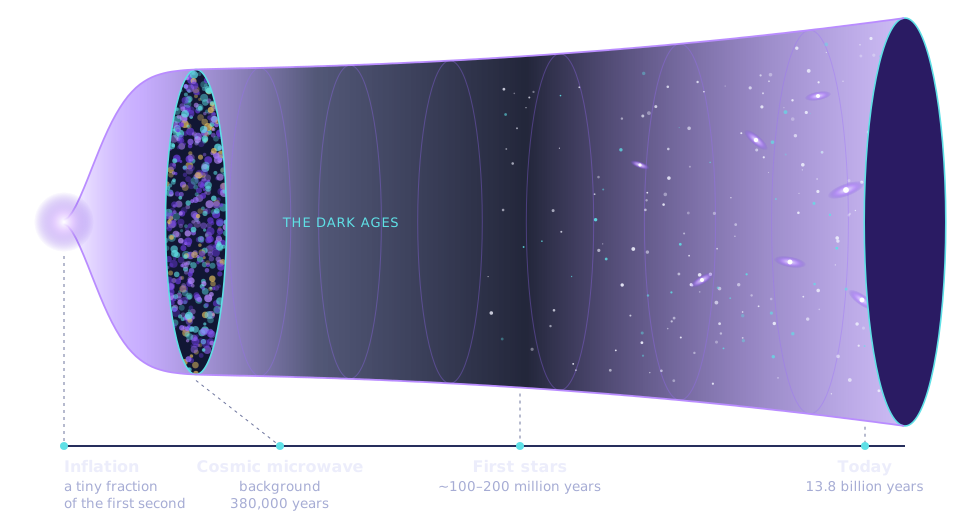
How long did inflation last?
- It may have lasted only about 10⁻³⁴ seconds, ending by around 10⁻³² seconds; the exact timing depends on the model.
- During that brief period, the universe may have expanded by an enormous factor.
- It offers a possible explanation for the large-scale uniformity of the CMB.
- Most cosmologists consider inflation a leading explanation, but its occurrence and precise mechanism remain uncertain.
Did inflation create the seeds of galaxies?
Cosmic inflation is the leading explanation for the universe's near-uniformity and for the small density variations we see in the cosmic microwave background.
- Inflation is an extremely rapid expansion during a tiny fraction of the first second.
- It may have stretched a small, relatively uniform region into the enormous region that became our observable universe.
- A proposed inflaton field may have driven this expansion.
- Quantum fluctuations in that field could have caused some regions to expand slightly more than others; these differences could have produced the density variations that later became the seeds of cosmic structure.
- Inflation is not directly observed, and other explanations for the variations have also been proposed.
Could inflation lead to a multiverse?
One possible implication of inflation: the larger space beyond our observable universe might keep inflating, with other regions forming their own pockets of universe.
- These hypothetical pockets could undergo their own hot, dense phases and later develop galaxies.
- Some hypotheses suggest pockets could collide, potentially leaving a recognisable feature in the CMB.
- Searches for such signs of collisions have not found them.
This remains a hypothesis, not an established observation.
Peer-reviewed references
- Guth (1981). Inflationary universe: A possible solution to the horizon and flatness problems. Physical Review D 23, 347-356. doi ↗The paper that named inflation and showed how it addresses the horizon and flatness problems.
- Linde (1982). A new inflationary universe scenario: A possible solution of the horizon, flatness, homogeneity, isotropy and primordial monopole problems. Physics Letters B 108, 389-393. doi ↗The "new inflation" scenario with a slowly rolling field.
- Starobinsky (1982). Dynamics of phase transition in the new inflationary universe scenario and generation of perturbations. Physics Letters B 117, 175-178. doi ↗How quantum fluctuations during inflation produce density perturbations.
- Guth & Pi (1982). Fluctuations in the New Inflationary Universe. Physical Review Letters 49, 1110-1113. doi ↗Calculation of those density fluctuations.
- Planck Collaboration (2020). Planck 2018 results. X. Constraints on inflation. Astronomy & Astrophysics 641, A10. doi ↗CMB tests of inflation: consistent, but not proof.
- BICEP/Keck Collaboration (2021). Improved constraints on primordial gravitational waves using Planck, WMAP, and BICEP/Keck observations through the 2018 observing season. Physical Review Letters 127, 151301. doi ↗The upper limit on primordial gravitational waves; no detection so far.
- Guth (2007). Eternal inflation and its implications. Journal of Physics A: Mathematical and Theoretical 40, 6811-6826. doi ↗Eternal inflation and the pocket-universe idea.
- Feeney et al. (2011). First Observational Tests of Eternal Inflation. Physical Review Letters 107, 071301. doi ↗Search for bubble collisions in the CMB, with no significant detection.